thumbnail image
Foxburrow Grange Nursing Care home. Colchester
Foxburrow Grange. Owned & managed by Outlook Care
Tel: 01206 586900
  • Types of Care 
    • Person Centred Care
    • Residential Care
    • Nursing Care
    • Respite Care
    • Dementia Care
    • Dementia Care FAQ's
    • Early Onset Dementia Care
    • Palliative Care
    • End of Life Care
  • Community 
    • Meet The Team
    • Foxburrow Grange Reviews
    • News & Events
    • National Care Awards
    • Activities Program
    • Food & Nutrition
  • Gallery 
    • Foxburrow Grange Video
    • Around Foxburrow Grange
    • Life at Foxburrow Grange
  • FAQ 
    • Care Home Insights
    • Care Home Fees & Funding
    • Care Home Services
    • Frequently Asked Questions
    • Care & Health Support
  • Join the Team 
    • Join the Team
    • About Outlook Care
    • Current Vacancies
    • Staff Stories
  • Contact Us 
    • Enquiry Form
    • Download Brochure
    • Whistleblowing Policy
    • Nursing Care Near Me
  • …  
    • Types of Care 
      • Person Centred Care
      • Residential Care
      • Nursing Care
      • Respite Care
      • Dementia Care
      • Dementia Care FAQ's
      • Early Onset Dementia Care
      • Palliative Care
      • End of Life Care
    • Community 
      • Meet The Team
      • Foxburrow Grange Reviews
      • News & Events
      • National Care Awards
      • Activities Program
      • Food & Nutrition
    • Gallery 
      • Foxburrow Grange Video
      • Around Foxburrow Grange
      • Life at Foxburrow Grange
    • FAQ 
      • Care Home Insights
      • Care Home Fees & Funding
      • Care Home Services
      • Frequently Asked Questions
      • Care & Health Support
    • Join the Team 
      • Join the Team
      • About Outlook Care
      • Current Vacancies
      • Staff Stories
    • Contact Us 
      • Enquiry Form
      • Download Brochure
      • Whistleblowing Policy
      • Nursing Care Near Me
Contact Us
Foxburrow Grange Nursing Care home. Colchester
Foxburrow Grange. Owned & managed by Outlook Care
Tel: 01206 586900
  • Types of Care 
    • Person Centred Care
    • Residential Care
    • Nursing Care
    • Respite Care
    • Dementia Care
    • Dementia Care FAQ's
    • Early Onset Dementia Care
    • Palliative Care
    • End of Life Care
  • Community 
    • Meet The Team
    • Foxburrow Grange Reviews
    • News & Events
    • National Care Awards
    • Activities Program
    • Food & Nutrition
  • Gallery 
    • Foxburrow Grange Video
    • Around Foxburrow Grange
    • Life at Foxburrow Grange
  • FAQ 
    • Care Home Insights
    • Care Home Fees & Funding
    • Care Home Services
    • Frequently Asked Questions
    • Care & Health Support
  • Join the Team 
    • Join the Team
    • About Outlook Care
    • Current Vacancies
    • Staff Stories
  • Contact Us 
    • Enquiry Form
    • Download Brochure
    • Whistleblowing Policy
    • Nursing Care Near Me
  • …  
    • Types of Care 
      • Person Centred Care
      • Residential Care
      • Nursing Care
      • Respite Care
      • Dementia Care
      • Dementia Care FAQ's
      • Early Onset Dementia Care
      • Palliative Care
      • End of Life Care
    • Community 
      • Meet The Team
      • Foxburrow Grange Reviews
      • News & Events
      • National Care Awards
      • Activities Program
      • Food & Nutrition
    • Gallery 
      • Foxburrow Grange Video
      • Around Foxburrow Grange
      • Life at Foxburrow Grange
    • FAQ 
      • Care Home Insights
      • Care Home Fees & Funding
      • Care Home Services
      • Frequently Asked Questions
      • Care & Health Support
    • Join the Team 
      • Join the Team
      • About Outlook Care
      • Current Vacancies
      • Staff Stories
    • Contact Us 
      • Enquiry Form
      • Download Brochure
      • Whistleblowing Policy
      • Nursing Care Near Me
Contact Us
Foxburrow Grange Nursing Care home. Colchester
  • Care Home Activities at Foxburrow Grange

    Person Centred Care Activities for Elderly and Dementia Care

    Foxburrow Grange Person-Centred Care Activities Program
  • Person Centred Care Based Activities at Foxburrow Grange

    Our Wellbeing co-ordinator is committed to continuous learning and improving the activities program at Foxburrow Grange.

    We are members of NAPA (National Activity Providers Association) which supports the care sector to prioritise wellbeing by promoting the importance of activity, arts and engagement. We also work closely with the FaNs Network - FaNs (Friends and Neighbours network) is a charity that strives to keep older people in Essex care homes involved with and connected to their wider community. At Foxburrow Grange we engage with them in a variety of projects such as Walk and talk, Bake-off competitions, Sports days and Grand friends project, which enables our residents to remain in touch with not only members of the community, but other care home residents too. 


    About Foxburrow Grange Activities Program

    We are dedicated to providing a stimulating and supportive environment for all our residents and offer a wide range of person-centered activities tailored to our resident's needs, desires, abilities, and disabilities.

    Person Centred Care Based Activities at Foxburrow Grange

    Resident Activities

    We focus on physical, mental, and social wellbeing through:

    • Physical Activities: 
      Seated sports, chair yoga, music & movement (regularly offered)

    • Mental Activities: 
      Book club, memory games, quizzes, reminiscence therapy, doll therapy

    • Sensory Activities: 
      Animal therapy visits, 'Namaste sessions' with massage, sensory lights, and relaxing music

    • Cognitive & Social Activities: 
      Arts & crafts, table-top games (including wheelchair-accessible options)

    • Seasonal Activities: 
      Gardening, planting, and nurturing flowers, growing vegetables, bench painting
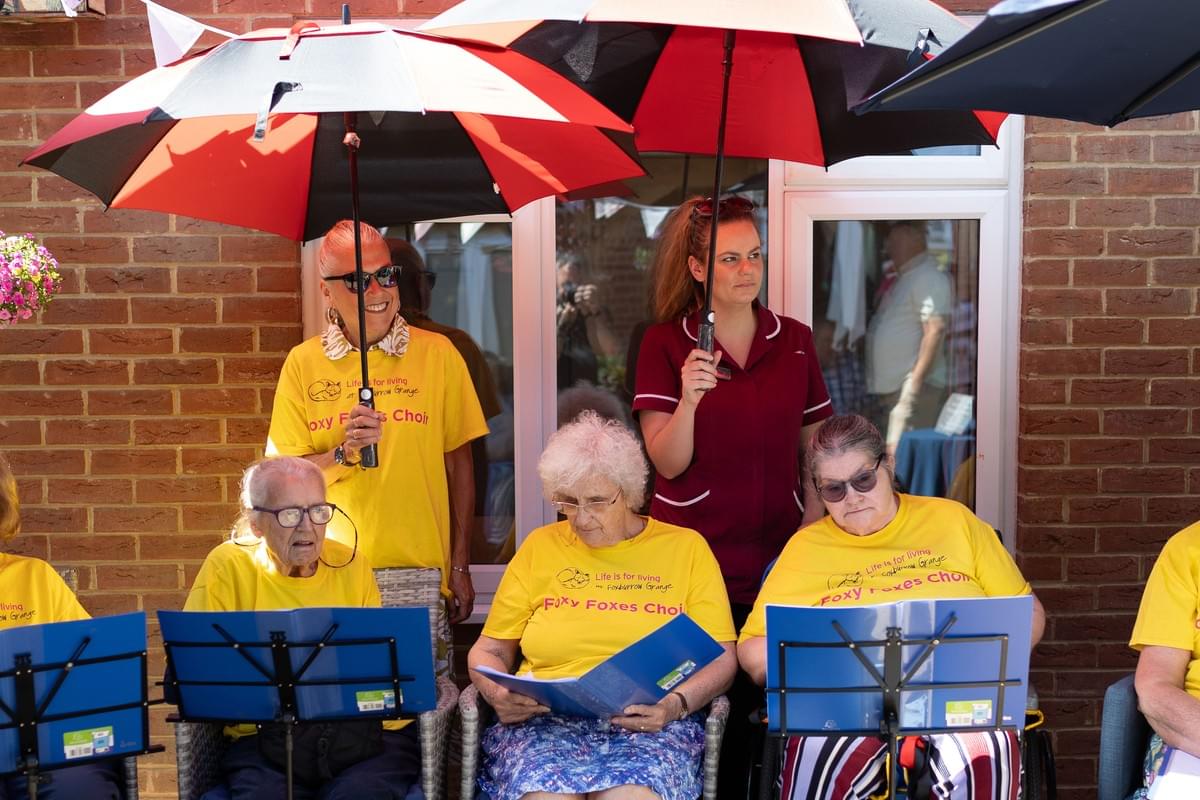
    Foxburrow Grange 'Foxy Foxes' - Dementia Choir

    Events & Initiatives for Residents

    • Special Events:
      We celebrate various occasions throughout the year, including International Day, Fashion Day, Spring Ball, tea parties, and Dignity Action Day. Music is included in many activities, with sing-alongs and regular practices with our own Dementia choir, which performs at events.

    • Community Engagement:
      We actively engage with the community through partnerships with charities, schools, nurseries, and the Butterfly Blue Day nursery. We attend monthly Dementia cafes and are registered with the Adopt a Grandparent project. Additionally, we offer regular cheese & wine tastings, baking sessions, and upcoming workshops with the Mercury Theatre in Colchester.

    • Resident & Family Involvement:
      Resident wishes are a priority in planning activities. This feedback is gathered through surveys and conversations, and we encourage relatives to be involved. Our activities are open to residents' families, fostering quality time and creating memories. Our dementia choir particularly welcomes community members who wish to sing along.
  • Discover the latest activities, news and events at Foxburrow Grange. Click button :

    News & Events at Foxburrow Grange
  • 12 Dementia Care Activity Principles

    Below is an overview of 12 dementia care activity principles and some of our tips.

    1. Activity should have a sense of purpose and engagement

    Some activities are designed to assist the person maintain or restore certain functions, such as eating more independently. But all activities need to capture the person’s interest; or else the activity will be of little or no value. When applying all the other principles, the activities should result in a pleasant, rewarding, and positive interaction.

    2. Always invite the person to participate

    The first few minutes of your visit with a dementia sufferer are often the most important. It is caring to introduce yourself on every occasion; you may consider this unusual at first but is important unless the person easily and obviously recognises you (e.g., saying your name and your relationship to them followed by saying that you have come to visit them today and would they mind helping you with some things.)


    One of the key principles is checking , can the person read , use the most appropriate font , check if they retain information , for example my name is ******, then ask what is my name , check if they answer ot do you have to repeat , this helps establish communication methods with the resident.


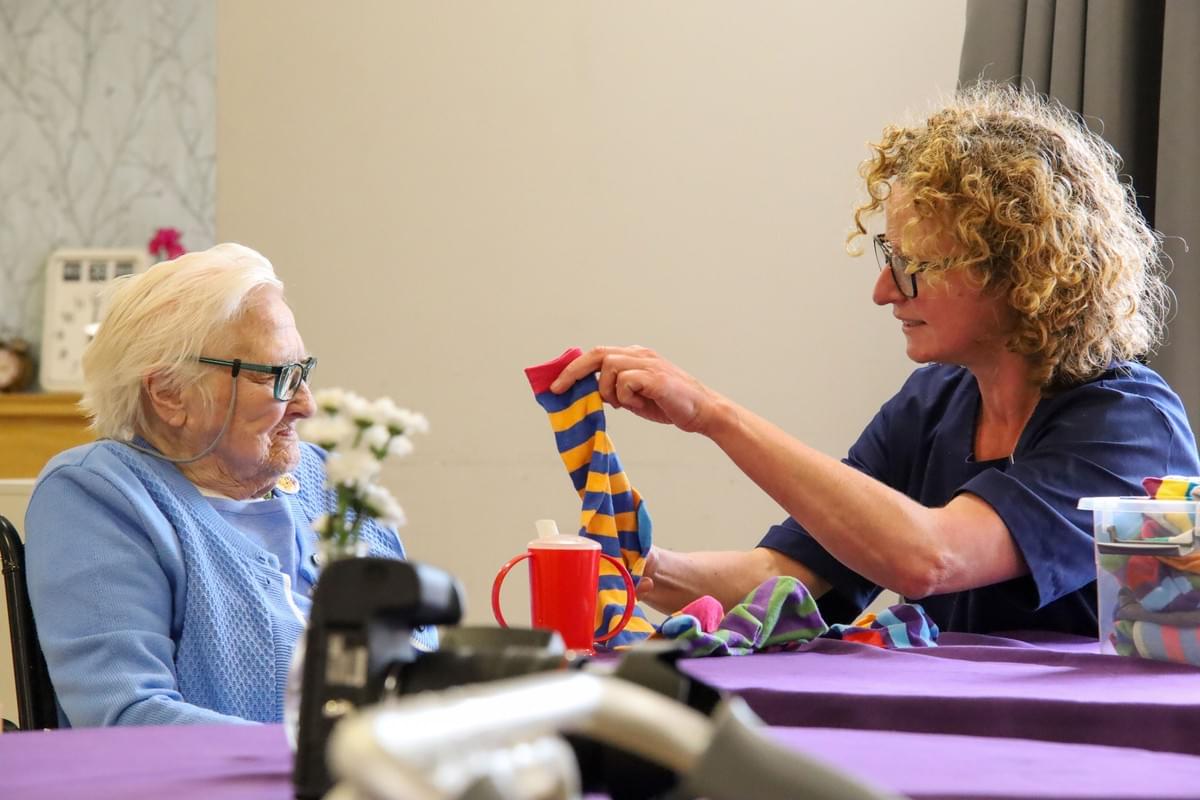
    Once you have established a connection, you can then build on this foundation (e.g., “would you like to arrange some flowers or pair some socks?”) Importantly you should feel comfortable in this interaction and the person’s response well be the best indicator of what you should do. If the person is not interested, try something else.

    3. Offer choice whenever possible

    As exampled above, it is helpful to present the person with a choice. Plus, when offering this choice, it is helpful to present visual prompts for each (e.g., a flower and a sock). This enables the person to respond more easily. Conversely general questions such as ‘What would you like to do today?’ can be very difficult for a dementia sufferer to answer.


    Should the person find it hard to choose the first time, you can take the lead. Choose something you think will be engaging or of interest. Start demonstrating how this activity works, invite them to participate. Again, you will then have to observe their response to decide if you should continue with this activity. If you think that their attention is wandering, you may want to change.

    4. Talk less; demonstrate more

    The first part of this principle, ‘Talk less’, very much depends on the person’s capability to speak. How much you speak should match how much they speak. If the person is (or has become) a chatterbox, feel free to chat just as much. If half of what they are saying sounds somewhat confused, it still may be good to continue talking with them. Just speak in a calm and warm voice, this may not result in any meaningful conversation but can still have a reassuring and calming effect on the person. You are acknowledging and honouring their wish to socialise and communicate with you.


    However, there are numerous reasons why the person may have become less comfortable with speech. They may lose the ability to speak or may even revert back to a first language. They may still be able to speak English but become frustrated because they are aware that their speech is confused or because they lose their train of thought. In such instances, it is best to avert this frustration and reduce speech in your interaction as much as possible. This may require some practice and, again, the person’s response is the main indicator to determine if you can still use some basic sentences or if it is best to greatly reduce your spoken words throughout your visits.


    As with most things, the person’s preference may change over time.

    Regardless of how much speaking you do, you should always demonstrate every step of an activity and repeat your demonstration until the person is able to imitate unless they have lost interest in which case it may be time to change activities.

    5. Physical skills; focus on what the person can do

    By accommodating any physical impairment, the person may struggle with, will always help your interaction. Many elderly suffer some visual and hearing loss, so well-adjusted glasses and hearing aids can improve the person’s experience. Sometimes one ear may function better than the other, or it is found to be easier for the person to reach and lift one arm than the other. With regards to vision, it may help to test a couple of print sizes to establish if and what the person is able to read. You may want to move around your reading material as well, to find where they are best able to see.


    It is usually easiest to do the activities at a table but be mindful that some chairs can be uncomfortable (especially for people who have had hip problems). Again, trialling a number of set-ups may result in an optimal environment to start the activities. For example, a TV tray may fit over the lap of someone sitting up in bed, and activities can be performed on the tray.

    6. Match your speed with the person you are caring for

    It is mostly more effective when communicating with most dementia sufferers to slow down, both in speech and movement. Don’t however speak louder because the change in tone may agitate the person. With the hearing impaired, it is best to sit close by and speak in a calm tone. Even if they can’t hear exactly what you are saying, the sound and tone of your voice may be reassuring to them. Plus, by demonstrating each step of each activity, you can communicate what you are asking them to do anyway.


    You may also need to adjust the speed at which you are moving. Your normal pace may be too fast and may add to the person’s confusion. It is best to observe their response to establish the best pace to be working at. As a general rule, it is best to work at a pace that matches the pace of their movements.

    7. Use visual hints, cues or templates

    When inviting the person to participate, you should use visual cues that represent the activities you are suggesting. Whenever you give them another choice, you can continue to use these visual prompts.


    The main cue to use is pointing to direct the person to what you are asking them to do. After demonstrating the activity (repeatedly if necessary), the person may respond to your invitation to do the activity themselves. However, if the activity consists of a number of steps, the person may not remember all the steps. A first response could be to point from the object they are holding to the place where it should go. You can repeat this a number of times; hold their hand to put the object together, or gently take the object from them and demonstrate again – but always keep in mind that their self-independence is of importance in every activity too.

    8. Give the person something to hold

    This principle applies if the person is not actively participating in your activity, as may happen when you first introduce an activity and the person may need to adjust to this certain form of interaction first. For example, if you are screwing nuts and bolts together, you can hand the person one of each; or hand them the bolt and put the nut within reach on the table. The idea of this principle is that you first of all respect that they may not be ready to participate with what you have in mind. You may still present your materials to see if they capture interest

    You may want to try an activity that is of interest to you too – so be guided by the person’s response to observe if they share your interest. Even if they are just observing what you are doing, this may sometimes still be a positive interaction.

    9. Go from simple tasks to more complex ones

    It is good practice to prepare several activities for the person, which activities may change over time too. The person is likely to attempt two to three activities in half an hour; however sometimes a single activity may take all this time. On days that it is harder to engage the person, you may need to try more than three activities.


    It can be best to start with a simple version of each activity, to avoid frustration. The life of a person with dementia is full of things they are not managing, and these activities should not result in stress. Your activities need to be designed so that the person has every chance of feeling competent and appreciated. However, you do not want to make activities too simple, as this can result in loss of interest.


    This principle really focuses on observing the person. Let the person determine what activity you will be doing, and at what difficulty level and pace. They may not verbally communicate this, but you can see it from their response. Once they have chosen an activity, the observation starts. As soon as you feel that their interest is fading, you can make changes.


    Everything is an activity: even preparing materials for certain activities or clearing the table after you have finished with a certain activity. Just continue applying the principles!

    10. Break a task down into steps; make it easier to follow

    Every activity consists of steps, e.g., doing a jigsaw includes:

    1. looking at the picture (together)
    2. handing the picture to the person to hold
    3. looking at the puzzle
    4. looking at the pieces
    5. placing the pieces into the puzzle.

    You may be able to teach the person every step, one after the other, or they may only be able to do one step at a time. You can help by pointing and demonstrating each step until they are able to do the whole sequence.


    Handing them a pile of jigsaw pieces to sort may be too much to ask. However, if you present one piece after the other, the person can focus on each shape. The same applies to uncluttering the environment: clean the table you will be working at, present materials for one activity at a time, step by step.

    11. To end, ask: 'Did you enjoy doing this ?’ 

    It is not necessary to complete a task; the main purpose of the interaction is to engage someone’s interest. If the person does complete a task, you can ask them if they enjoyed doing it and would they like to do it again? In this way, they are in charge of what you are doing with them.

    12. There is no right or wrong. Think engagement

    This final principle is closely related to the first principle. The aim of your interaction is to pass some enjoyable time – that’s all. The person does not have to do everything ‘right’ (or anything for that matter); they do not need to complete an activity. If blue socks keep getting placed on the pile meant for red socks, does it really matter – as long as they are absorbed in the activity? Try not to correct the person if they are enjoying themselves. If they get frustrated by their mistakes, it is time to make changes.

  • More about Person Centred Care and Life at Foxburrow Grange

    Click images for more information

    Person Centred Care Principles

    Residential Care

    Foxburrow Grange
    News & Events

Foxburrow Grange care home. Colchester. Essex

Foxburrow Grange Care

Foxburrow Grange Services

Residential Care

Nursing Care

Respite Care

Dementia Care

Early Onset Dementia Care

Dementia Respite Care

Palliative Care

Our Community

Person Centred Approach

Person Centred Care Principles

Care Home Activity Principles

Food & Nutrition

Care Home Guidance

Frequently Asked Questions

Care Home Fees and Funding

Care Heath and Support

Contact Foxburrow Grange

Telephone

Email

Directions

News & Events

Reviews

Meet the Team

Careers at Outlook Care

  • COVID-19 IPC
  • Privacy Policy
  • Whistleblowing Policy

© Copyright Outlook Care

Outlook Care registered office: Foxburrow Grange, Ypres Road, Colchester, Essex, CO2 7NL

Outlook Care is a registered society under the Co-operative and Community Benefit Societies Act

incorporated on 24th January 1990 and recognised as charitable by HM Revenue and Customs.
Registered society number: 26988R.


Foxburrow Grange. Ypres Road. Colchester. Essex. CO2 7NL

Tel : 01206 586900
Email : foxreferrals@outlookcare.org.uk

See our other websites

  • Outlook Care
  • St George's Nursing Home. Witham

Foxburrow Grange photography by James Kirk

Digital Marketing by web-aviso

Terms & Conditions
Privacy Policy
    Home
    Call Us
    Email
    Find Us
Cookie Use
We use cookies to ensure a smooth browsing experience. By continuing we assume you accept the use of cookies.
Learn More